



Why "Generative Design" Shows Up in Every Pitch Deck
Autodesk democratized generative design with Fusion 360. Siemens, PTC and nTopology followed. In parallel, AI image generators like Vizcom, Krea and Midjourney have entered the mainstream. Additive manufacturing is becoming industrial-grade, and cloud computing has lowered the barrier to computationally heavy optimizations. The result: the term "generative design" appears in sales pitches, grant proposals and strategy decks, often without the people in the room agreeing on what they mean.
For product developers and engineering leads, this creates a real problem. Quotes from design partners, software vendors and internal teams look comparable on paper, while addressing entirely different technologies. Anyone purchasing "generative design" generically may end up with topology optimization where a parametric approach was needed, or an AI ideation workflow where they expected a manufacturable construction concept. The consequences are misallocated budgets, project misunderstandings and outcomes nobody really wants to own.
In our work as an industrial design studio, we encounter this ambiguity regularly. This article separates the three relevant technologies clearly, shows with our own project example, the Continental Mountain King, how parametric design actually works, and explains where the real leverage for manufacturers lies: in connecting algorithm with manufacturing reality.
Topology Optimization, the "Classic" Generative Design
Topology optimization is the oldest of the three approaches. Established since the 1990s, it is now available in every major CAD suite, including Autodesk Fusion 360, Siemens NX, PTC Creo, Altair Inspire and nTopology. The designer or engineer defines a design space, load cases, fixed points and the intended manufacturing process. The algorithm then iteratively removes material from this space until the thinnest still load-bearing structure remains. The result is a single optimized design, often organic and biomimetic in appearance.
Typical applications are found wherever weight is a quantifiable product advantage and the manufacturing process supports the resulting freeform geometries:
- Lightweight construction in aerospace, motorsport and medical technology
- Brackets, mounts and structural parts for additive manufacturing
- Heat exchangers and heat sinks with complex internal geometry
- Implants and patient-specific components with individual load profiles
The limitations are equally clear. The method requires precise, realistic load cases, and feeding in the wrong loads produces an optimal solution to the wrong problem. The bionic-looking results are difficult to produce in conventional injection molding, which means without additive manufacturing or multi-axis CNC machining, most of the savings potential remains untapped. And: aesthetics, haptics and semantic product language are not inputs. A topology-optimized component is functional, but not automatically a good product.
Parametric and Algorithmic Design
In parametric design, the designer writes rules instead of shapes. Changing a single parameter, such as user size, batch size or material thickness, automatically updates the entire geometry. The process feels more like programming than traditional modeling. Defining the right rules can produce hundreds of valid variations in a short time. Typical tools include Grasshopper for Rhino, Autodesk Dynamo, Siemens Parasolid and Houdini.
The underlying principle is straightforward. A point in three-dimensional space is described by xyz coordinates. Changing the values moves the point. Connect multiple points into surfaces and bodies, and you get geometries whose form is fully controlled by their underlying coordinates. Complex parametric models build on this: mathematical functions link many parameters together, so that a single rule set can produce countless valid variations without modeling each one manually.
Parametric design pays off wherever variant diversity is part of the business model. Product families with many size variations, customizable products in orthopedics, furniture or jewelry, complex surfaces in architecture and interior design, or packaging development with automatically generated variations are classic use cases. Anyone serious about mass customization cannot avoid parametric methods.
That said, the barrier to entry is high. A well-built parametric model is a development project in its own right, not just a CAD exercise. The algorithm is only as good as the underlying rule set, and poorly defined parameters quickly produce unusable variations at scale. Parametric models also need to be documented and maintained like code, which makes handover to other teams effortful.
Practical Example: How a Mountain King Tire Tread Is Designed Parametrically
Tire treads are a textbook case for parametric design, though that may not be obvious at first glance. What looks like a freely composed pattern on a mountain bike tire actually follows strict rules: knobs must sit at defined distances, their heights and widths influence grip, rolling resistance and self-cleaning, and their edge angles determine traction and braking behavior. Any single tire is part of a family of variations for different use cases, from XC racing tires to enduro treads, and each variation modifies exactly those parameters.
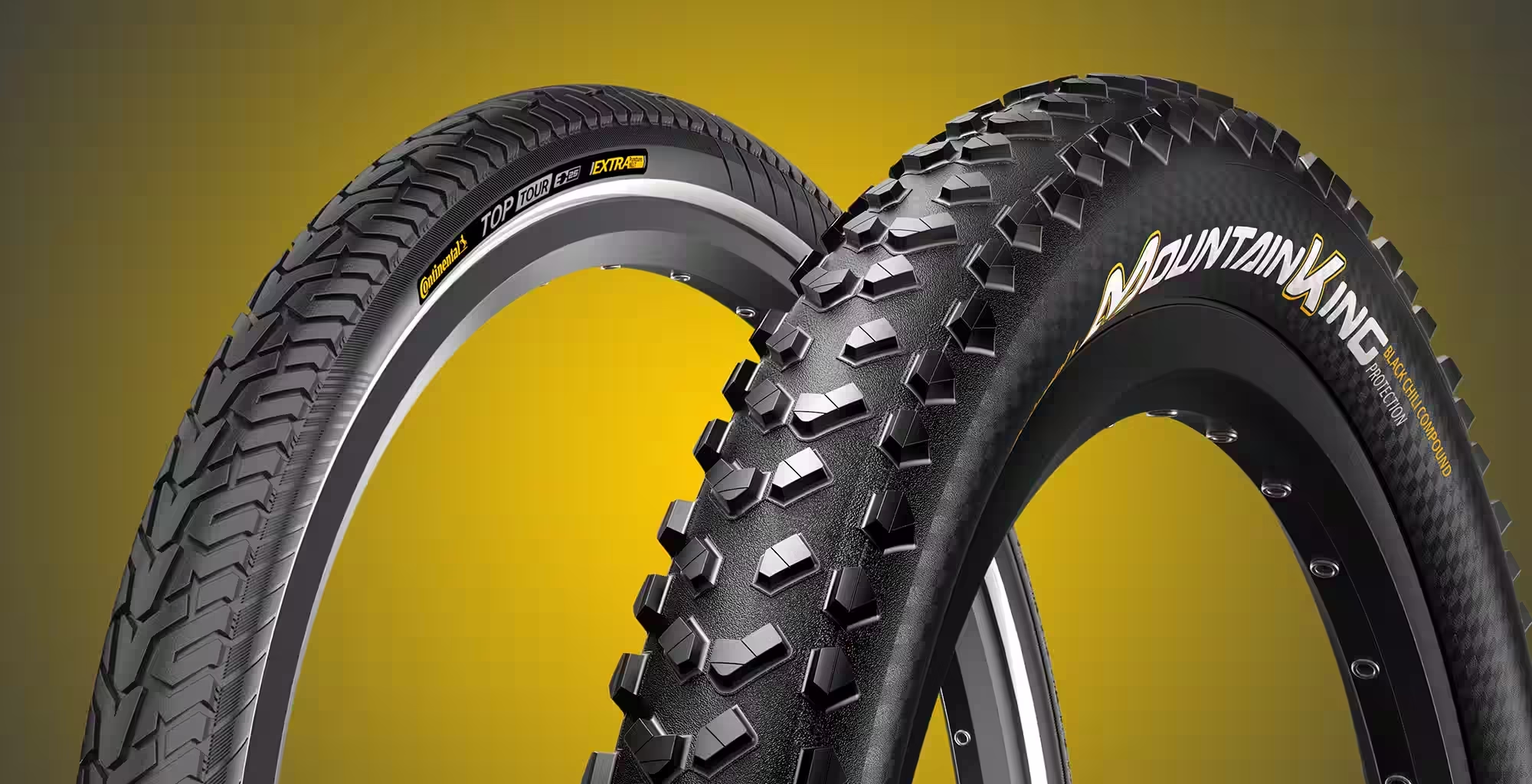
For the design development of the Continental Mountain King, we modeled these parameters in Grasshopper, a visual programming environment for Rhino. Instead of modeling each knob individually, the parametric model defines the logic of the tread: how many knobs sit on which line, at what distance, with what height and edge geometry. Change a parameter, and the model automatically generates a complete new tread without losing the design language.
For this to work, the anatomy of a single knob has to be clearly defined. Every knob consists of multiple regions with specific functions, and each appears in the parametric model as an individual controllable dimension.
Based on this anatomy, we defined the central control variables in the Grasshopper model. Adjustable parameters include the spacing between knobs, their heights and widths, and the angles of knob face, leading edge, trailing edge and side edge. Each of these is a slider in the model, and every change immediately produces a new, fully constructed variation of the tread. This allows targeted profile development for different terrains without losing the underlying design principle.
What matters just as much is what the parametric model does not do. It does not decide which knob spacing works best for which terrain. It doesn't know how rubber compound and tread geometry interact. It doesn't know the brand values of Continental. The decisions about which profile logic is right for which tire are made by designers and engineers together. The parametric model is the tool that implements these decisions, more precisely and faster than manual modeling ever could.

This is where the value of the approach extends beyond a single product. A parametric model, once properly built, can be transferred to other tires in a series, adapted to new requirements, and serves as documentation of the design DNA of a product family. The upfront effort pays back over years, when one tire becomes a family of variations.
AI-Driven Design Generators
The third and youngest category is AI image generators, which produce visual concepts from text prompts or sketches. They work on the image level, not on the geometry level. The result is not a CAD file but a rendering or sketch that feeds back into the traditional design process as inspiration. Tools like Vizcom, Krea AI, Runway and Adobe Firefly have matured significantly over the past two years and are now usable for professional ideation work.
The strength of these tools lies in early project phases, when moodboards, style directions and initial form ideas need to be explored quickly. In a single week, hundreds of variation directions can emerge, from which the design team selects the most promising for the CAD phase. AI-generated visualizations are also useful for client communication and early-stage approvals, because they accelerate otherwise lengthy decision phases.
The limitations are fundamental. AI image generators don't produce manufacturable data. The result looks like a product but isn't one. Undercuts, wall thicknesses, draft angles and assembly logic are entirely absent, because the algorithm optimizes pixels, not geometry. Copyright questions around training data are also unresolved in the EU, which can become a real risk for brand-relevant products.
The Real Leverage: Bringing Generative Design and Manufacturing Together
The most common mistake we see in projects is thinking in tool categories instead of development logic. Topology optimization is purchased because the software is available, not because the manufacturing strategy actually supports it. The consequence: bionic-looking parts that cannot be produced economically at series scale.
A concrete example: a topology-optimized housing part that saves 35 percent weight in 3D printing is impressive in the prototype phase. In injection molding at an annual volume of 100,000 units, the picture changes. Tooling for organic freeform shapes is more expensive, draft angles are missing, and cycle times rise. The supposed advantage disappears, often by the second generation of manufacturing.
Generative design only delivers its value when the manufacturing process, batch size and lifecycle are part of the algorithm's input from the start. This is not a software question, it's a design decision. In our approach to design for manufacturing and assembly, these constraints belong in the brief, not in the rework loop.
The environmental perspective reinforces this point. Reducing parts and optimizing material use lowers production cost and CO₂ emissions simultaneously. This is exactly the logic the EU Ecodesign Regulation demands. How this translates into practice, we discussed in our article on sustainable product design and the ESPR. For manufacturers, the takeaway is clear: generative design is not a plugin for an existing development process. It is a method that belongs in the concept phase, with clear manufacturing strategy, realistic load assumptions and documented target values. Anything else produces nice renderings and expensive corrections later.
What Generative Design Doesn't Deliver
For all its capabilities, generative design has clear limitations that rarely come up in sales conversations. Three of them matter most for decision-makers.
Algorithms optimize against defined goals, they don't set them. Which product gets developed at all, which market it addresses, which brand it represents, these are strategic decisions. A generative tool doesn't answer these questions, it presupposes them. Anyone entering generative design with unclear strategy gets optimized solutions to the wrong problem.
Similarly, an algorithm doesn't know the difference between a Bosch professional tool and a Parkside DIY device. Brand values, haptics, visual calm, interaction logic and emotional appeal arise from deliberate design decisions. These don't fully translate into parameters. How strongly design influences market success, we explored in our article what is product design.
And finally: the algorithm doesn't know that your tooling supplier doesn't have a five-axis CNC mill, or that your injection molder is locked into two-plate tooling. Every constraint missing from the brief is missing from the result. Generative design is not a shortcut around manufacturing planning, it's its extension.
When Each Approach Pays Off
Choosing the right approach depends less on the technology trend than on the actual project context. Topology optimization is the right choice when weight reduction is a measurable product advantage and the manufacturing process supports freeform geometries, meaning additive manufacturing or multi-axis CNC machining. Structurally loaded parts like brackets, mounts and joints benefit the most.
Parametric design pays off when a product family with many variations is planned, or when customer-specific adaptations are part of the business model. Complex surfaces with patterns or lattice structures, and rule-based geometry that is applied repeatedly, are classic parametric use cases. The Mountain King case shows the lasting advantage of this approach: once the parametric model is well-built, it can be transferred to other products in the series.
AI image generators play their strongest role in the ideation phase, when many style directions need to be explored in a short time. They are tools for moodboards and early visualization, not for final construction. This requires the design team to use them deliberately as a source of inspiration, with the traditional design process running cleanly afterward.
Equally important is recognizing when none of the three approaches is the right fit:
- When brand identity, haptics and user experience are the priority
- When the manufacturing strategy is not yet defined
- When the product is primarily about interaction logic and usability
- When strategy, target audience and differentiation are still open
In many of our projects, the strongest results come from combining approaches: AI tools in ideation, classic industrial design in form-finding, topology optimization for individual structural components, parametric approaches for variant families. Which combination is right depends on the project, not the tool.
Conclusion: Algorithms Co-Design, but They Don't Decide
Generative design is powerful, but not an autopilot. The three technologies under this label address different phases and goals in the development process and must be clearly distinguished in any project. Value emerges not from the software itself, but from asking the right questions, defining realistic constraints, and having a clear manufacturing strategy.
For manufacturers, this means: anyone using generative design should understand it as part of an integrated design process, not as a shortcut around design strategy. Tools reduce effort, they don't replace decisions. The core questions, which product is developed for which market with which brand and which manufacturing setup, remain human questions.
If you're considering where generative methods could fit into your product development, and how they connect with your manufacturing strategy, get in touch. We classify technologies not by tool logic, but by what your product needs to achieve in the market.