Nothing leaks.
Rugged in the field. Discreet in the room.
Industrial Design for Defense and Security Equipment: Rugged, intuitive to operate, from handheld Optronics to Unmanned Systems.
Equipment doesn't fail in the lab. It fails at night, in the rain, with cold fingers inside a glove, exactly when someone is counting on it. Anyone developing for rescue services, security, public agencies or professional field use knows this. Here a product has to do both: impress and endure.
Handheld optronics, portable field equipment, unmanned platforms on water and in the air: for more than 20 years we have developed industrial design that thinks about ruggedness, intuitive operation and manufacturability from the first sketch.
Our work has won multiple awards: iF Design Award, Red Dot and Plus X Award, more than 45 distinctions in 20 years. We extend your engineering without taking control away from you, and we treat projects here as confidential, under a non-disclosure agreement from the outset if you prefer.
What you get with PROJEKTER
We understand your Problems
Few environments are as unforgiving as a real deployment. These are the themes that decide whether a device is fit for purpose, and we build them in from the first sketch.
From Concept to Series, from a Single Source. We cover the whole Chain, tailored to Field Use.
Rugged, field-ready design for optronics, portable equipment and unmanned systems. We develop form, control logic and materials so that a device is understood in use and your brand still comes through.
Glove-operable, in the dark, under stress. We develop complete control concepts and test them on physical ergonomic models: size, weight and switch position real, not simulated.
IP, IK and MIL-STD compliant structures through to production readiness. Sealing plane, parting line and internal build are planned from phase one, because corrections in phase three get expensive.
From concept to a production-ready data set, aligned with your own engineering team. Tolerances, sealing planes and supplier interfaces are resolved before tooling is cut.
Model making, 3D printing, CNC milling and 3D scanning under our own roof, including dedicated ergonomic models. That shortens iteration cycles considerably, because no external supplier sits between a design decision and a physical model.
Make concepts tangible early, including for confidential reviews. Photorealistic renderings and product animations for sales, trade shows and internal sign-off, without a prototype having to exist.
Three Studies that show how we think and work.
Ruggedness, operation and production readiness in one pass, from handheld optronics to unmanned platforms. Each of these studies was born at an extreme: darkness and gloves for the binocular, salt and waves on the water, range and weight in the air.
Why studies and not series products? Because nothing leaks. What we develop for clients through to production stays confidential. What we show openly are our own studies. And they reveal the thing that actually matters: how we think. A control layout that works in the dark; a structure that is sealed from phase one; a device that performs in the field without drawing attention. That thinking is what we bring to your project.
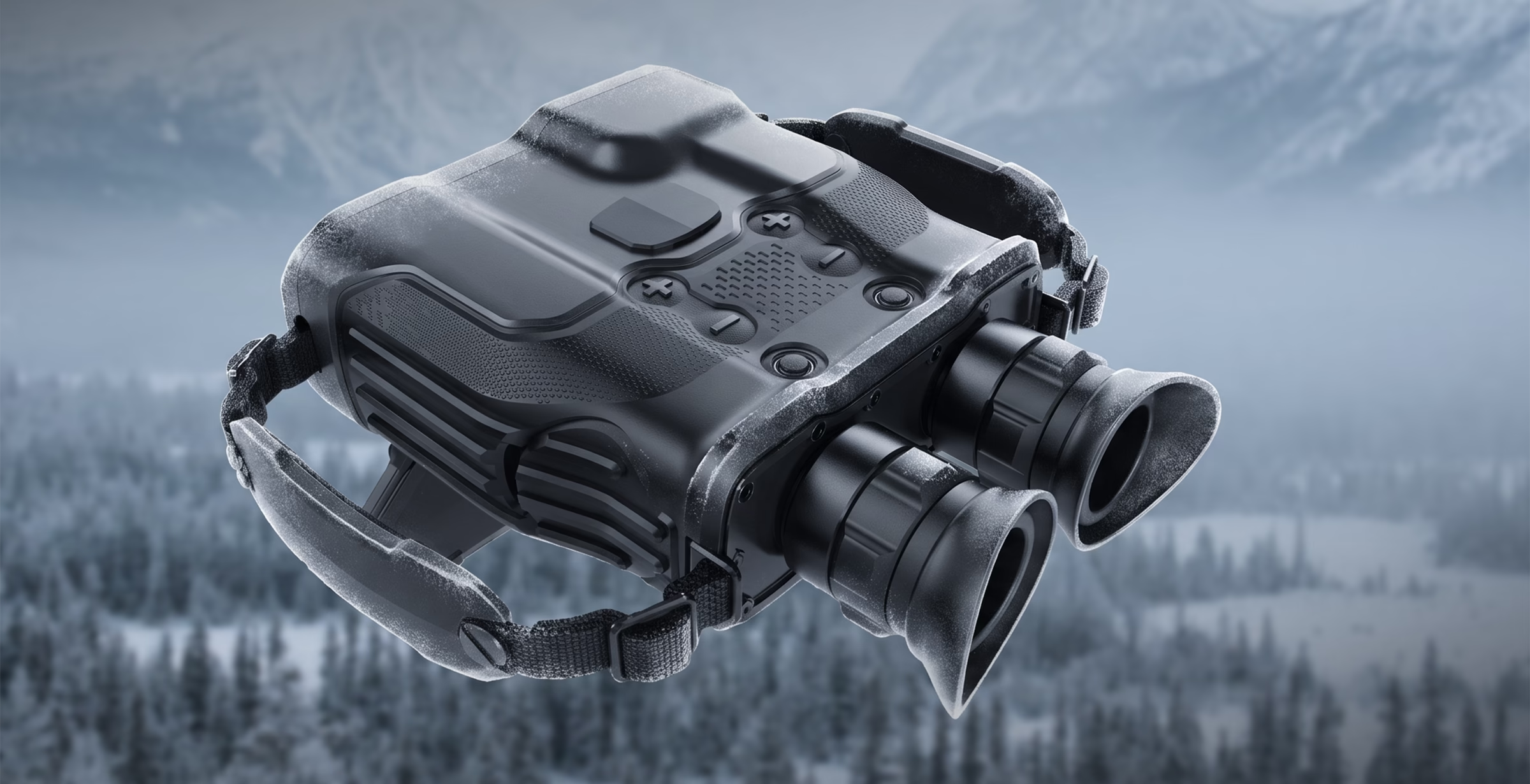
Together with our electronics partner b1 Engineering Solutions, we designed a digital binocular for a major German high-tech manufacturer, combining daylight and infrared imaging with an integrated laser rangefinder while meeting IP65, IP67 and IK06. The central requirement: operable blind, with gloves, in the dark, under stress, without instruction.
Users range from mountain rescue, fire services and customs to foresters, mariners and hunters. What connects them is not the situation but the expectation: equipment that is reliable and looks it.
We developed three fully worked design directions, from the calm, technical extrude through the precise tense to the tool-like tough, plus three complete control concepts on identical housing geometry. That kept the decision a question of operating philosophy rather than appearance.
We tested not on screen but on physical ergonomic models: size, weight and switch position real, so the thumb finds the button in the dark. The housing structure was conceived IP-compliant from phase one, with a planar parting line and a considered sealing plane, not sealed after the fact.
Result: IP67 and IK06 · operable blind · three fully worked design and control concepts → See the SEEQ design study in detail
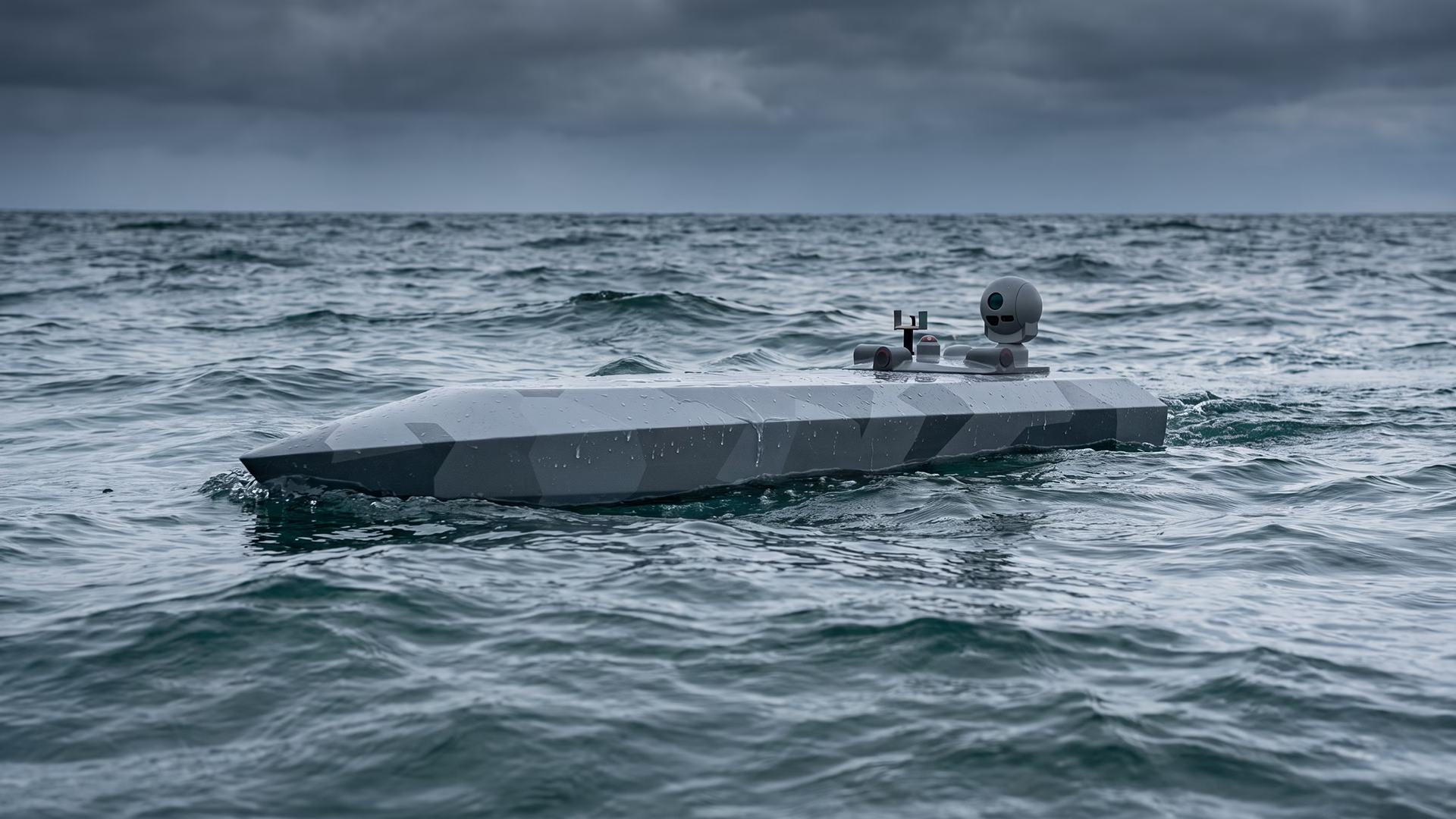
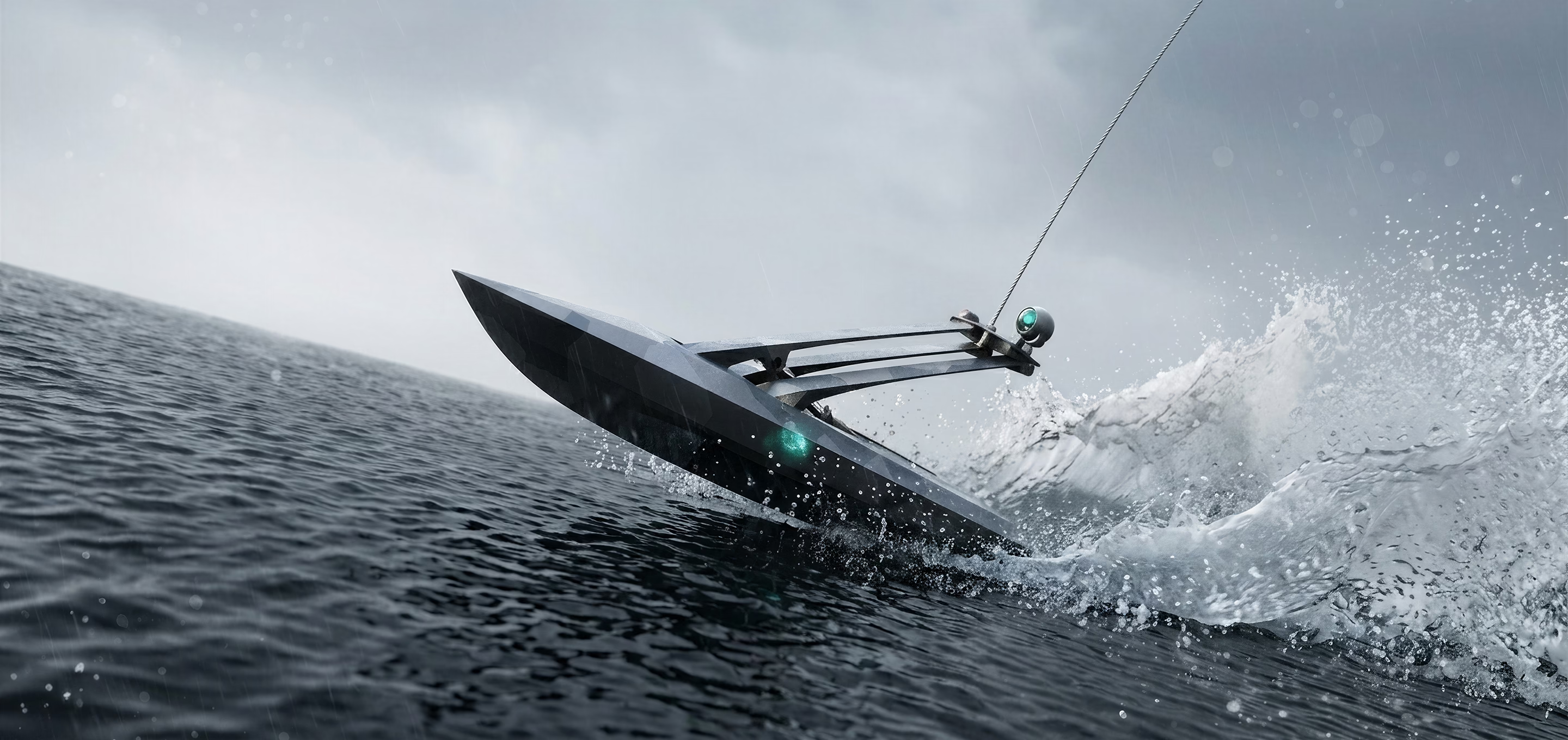
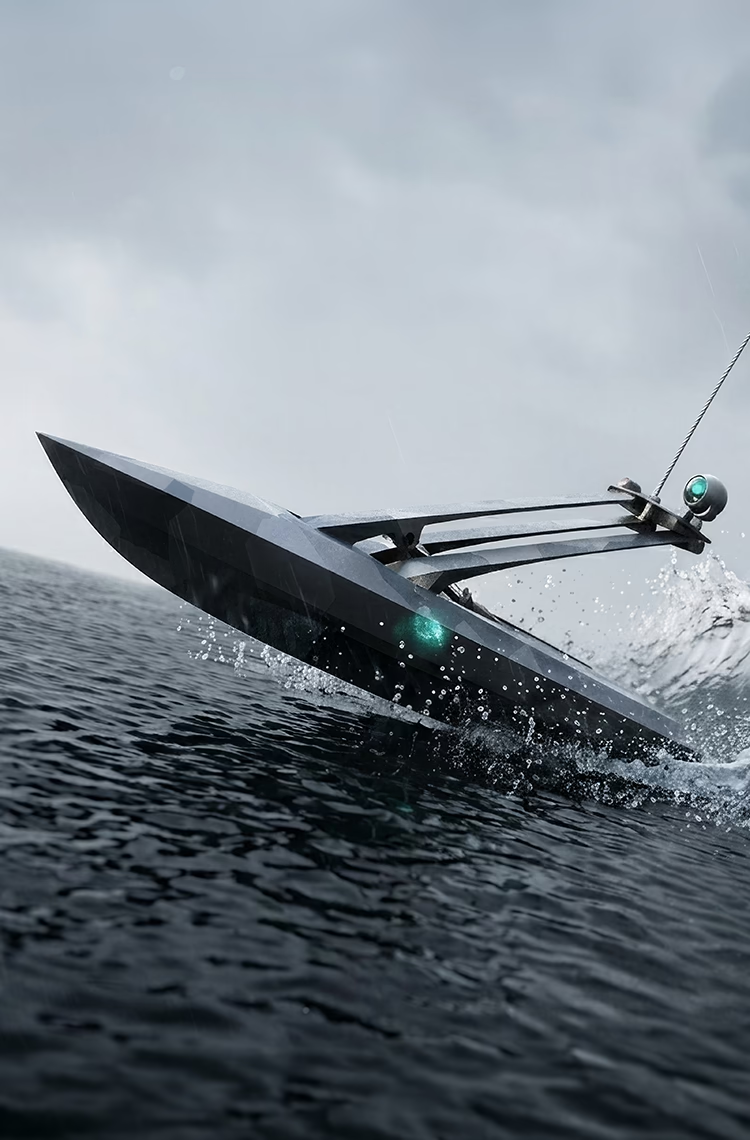
Different rules apply on water: salt, waves, corrosion. This design study addressed an unmanned platform for reconnaissance: sealed, corrosion-resistant and stable in attitude and buoyancy.
The design focus was a robust, watertight structure, safe handling during launch and recovery, and a form that stays controllable in heavy seas. Discretion is built in here too: minimal signature, clear function, nothing that draws the eye.
Design focus: watertight and corrosion-resistant · attitude-stable · optimized for handling
Conventional quadcopters spend almost all their energy simply staying airborne. Typical flight times run 15 to 25 minutes and the operating radius is limited accordingly. Fixed-wing aircraft are efficient but need a runway or catapult and cannot hover.
For a confidential client we brought the two together: a canard-style wing configuration with two wing pairs, the forward mid-wing generating roughly 60 percent of lift and the tail wing the remaining 40. For the airfoil geometry the choice fell on the Eppler E214, designed for low Reynolds numbers.
Lightweight construction down to the detail: a carbon-plate sandwich for the internal structure, tilting carbon rotor axes with up to 50 degrees of travel, and a carbon-Kevlar outer shell at the thinnest workable laminate thickness. A longitudinally adjustable battery compensates for different camera weights and keeps the center of gravity constant. The center section lifts off from above without tools, which makes battery changes under field conditions considerably easier.
As speed increases the wings take over weight compensation and unload the motors. The force vector shifts toward pure thrust, so range and endurance grow without losing VTOL capability and hover.
Result: VTOL and wing-borne flight in one platform · carbon-Kevlar lightweight construction · aerodynamically and manufacturing-optimized→ See the Endura Scout project
Many projects in this field cannot be outlined over the phone without giving something away. So we settle confidentiality before we discuss content, not after.
From idea to field-ready product: we bridge the gap between design ambition and rugged, production-ready reality, and we think about ruggedness, operation and manufacturing from the start.

We focus on what matters.
Deployment scenario, users, protection requirements (IP/IK).
Export Control and Dual-use classified early.
Misuse and Critical Failures considered from the Outset.

Coherent design languages with distinct character.
Physical ergonomic models, tested blind in the hand.
IP/IK compliant and cost-viable from the start.

Sealed, robust, service-friendly structure.
Protection ratings, durability, operation in the field.
Manufacturing-ready handover to series.

And we are happy to answer them.
For rescue services, security, public agencies and professional field use, from optronics through portable equipment to rugged gear. Many of these devices are deployed both in civilian and official contexts. Where dual-use considerations apply, we coordinate early with the relevant people on your side.
It depends on scope, ruggedness requirements and depth of manufacturing support, from a focused concept study to full support into series production. We quote transparently by project phase and give you a reliable estimate after a first, confidential conversation.
Yes. Depending on your capacity and preference we extend your existing engineering, or we take on the design work in full. Either way we coordinate closely with your development, manufacturing and supplier teams so the design holds up technically and commercially.
On projects with a security or defense dimension we clarify the project context, responsibilities and the circle of people with access at an early stage. Export control classification of the overall system and any required approvals remain with the client or their responsible export control function.
We work within the approved project and data scope and do not pass technical documentation on to further recipients or across borders on our own initiative.
At any stage: first idea, concept, or an existing device to be developed further. The earlier, the greater the leverage on ruggedness, operation and cost.
Yes, as a design objective. Protection ratings such as IP65 and IP67, impact resistance to IK, and environmental requirements per MIL-STD-810 (shock, vibration, temperature, dust, moisture) are treated as system requirements from phase one, not as a retrofit.
Certification and qualification itself is carried out by specialist test houses. That sits outside our scope and remains with you or your partners.