

Two Terms, One Mission: Creating Products That Inspire
Industrial design, product design, sometimes even consumer goods design – anyone working on the development of new products quickly encounters these terms. And just as quickly, a question arises: what exactly is what? Is there even a difference between industrial design and product design?
The short answer: yes and no. The long answer: it depends on who you ask and in what context. In this article, we clarify the terminology, trace the historical roots, and explain why this distinction matters more to your product development than you might think.
What Is Industrial Design?
Industrial design emerged during the Industrial Revolution, when machine-based mass production replaced artisanal craftsmanship. Suddenly, products had to not only function but also be optimized for industrial production. The term itself reveals a great deal: industry is at its core.
Industrial design focuses on creating products that are manufactured in series. It is about the perfect balance between aesthetics, function, and manufacturability. An industrial designer thinks about the production line from the very first sketch: which materials are suitable? How many individual parts are necessary? Can assemblies be simplified? Can tooling be produced cost-effectively?
This discipline bridges technical understanding and creative design. Industrial designers must master manufacturing processes such as injection molding, CNC machining, and sheet metal forming just as well as form-giving, ergonomics, and color theory. They work closely with engineers and speak their language. The goal: a product that not only looks good and works well, but can also be produced economically.
The Historical Development of Industrial Design
The Bauhaus movement in the 1920s had a defining influence on industrial design. "Form follows function" became the guiding principle. Designers like Dieter Rams later developed a design language at Braun that still resonates today. His ten principles of good design remain a standard reference in design schools worldwide.
In Germany, industrial design has a particularly strong tradition. The close integration of design and engineering expertise cultivated here has made German products internationally successful. From automotive design to medical technology to hand tools: industrial design "Made in Germany" stands for quality, precision, and durability.
What Is Product Design?
Product design is the broader, more encompassing term. It describes the shaping of any product, regardless of whether it is industrially manufactured or handcrafted. Product design can refer to physical objects, but also to digital products such as apps or software interfaces.
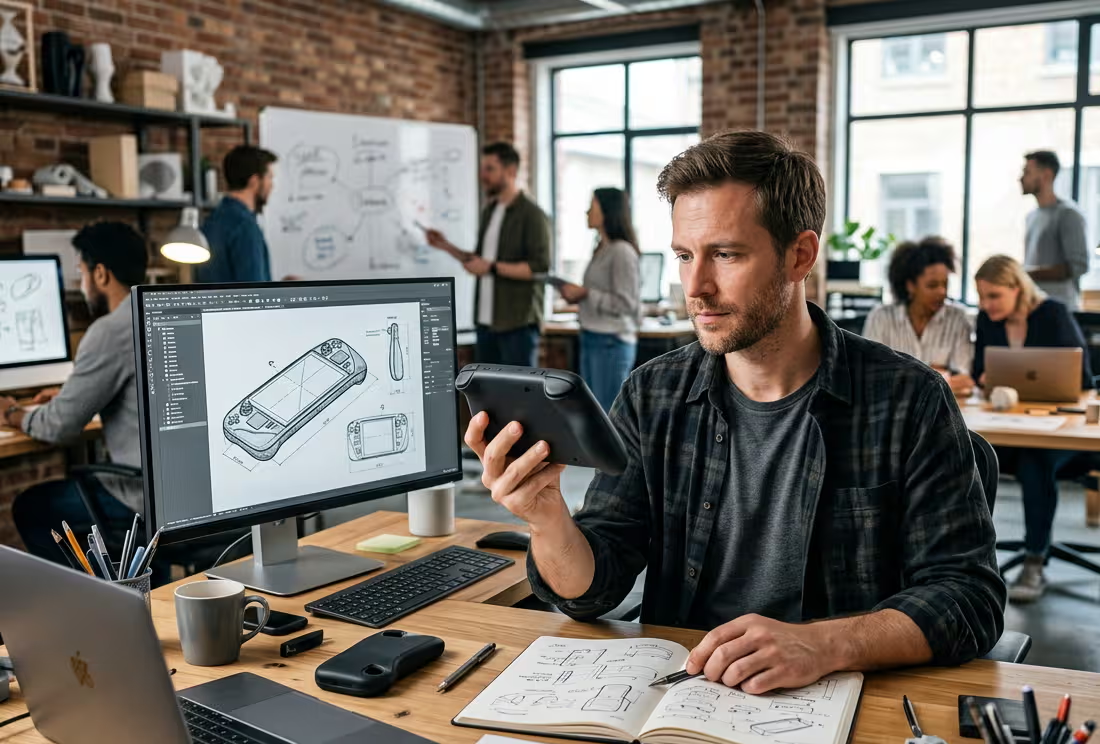
The focus in product design lies more strongly on the end user and their experience with the product. While industrial design incorporates production thinking, product design concentrates primarily on the question: how does a person interact with this product? What do they actually need? What problem is being solved?
Product designers often work more conceptually. They develop the fundamental idea of a product, define its function, and shape the user experience. The question of manufacturability often comes in a second step. This makes product design more flexible in early development phases, but also carries the risk that concepts may be difficult or impossible to realize.
The Difference in Academic Training
Differences also exist in the academic world. Industrial design programs traditionally place more emphasis on technical understanding, materials science, and manufacturing engineering. Product design programs focus more strongly on form-giving, user research, and conceptual work.
This distinction is increasingly blurring, however. Modern design programs combine both approaches, because professional practice demands exactly that: designers who think in a user-centered way while also understanding production.
What Industrial Design and Product Design Have in Common
As different as the terms may sound, in practice they overlap enormously. Both disciplines pursue the same goal: to create products that work, look good, and deliver genuine value to people.
Core Elements of Both Disciplines:
- Functionality: The product must reliably and intuitively fulfill its purpose.
- Aesthetics: Form, color, and surface design must be compelling and aligned with the brand.
- Ergonomics: The product must be comfortable and safe to use.
- Sustainability: Material selection, longevity, and recyclability are gaining in importance.
- Economic viability: The product must remain affordable, both in production and for the end customer.
In modern Design agencies such as PROJEKTER, both approaches merge into a holistic process. We start from the user perspective and simultaneously consider the reality of production. What good is the most beautiful concept if it cannot be built? And what does the perfect manufacturing solution achieve if nobody wants to buy the product?

When Do You Need Industrial Design, and When Product Design?
Many companies ask this question at the start of a project. The honest answer: you need both. However, with different emphases depending on the project phase and product type.
Product design is especially important in the early concept phase. When you are developing a new product idea, entering a new market, or driving innovation, you first need creative freedom. The central question here is: what do we actually want to create? For whom? With what benefit?
Industrial design becomes decisive once things get concrete. When the concept is established and implementation is on the horizon, hard facts come into play: materials, tooling, unit costs, manufacturing tolerances. Good industrial design can significantly reduce production costs here while simultaneously raising quality.
Real-World Examples
A manufacturer of power tools primarily needs industrial design. The products must be robust, produced in high volumes, and meet strict safety requirements. At the same time, ergonomics must be right, as tradespeople use them every day.
A start-up developing a novel kitchen gadget typically begins with product design. The idea must first be compellingly shaped, prototypes need to be built, and market feedback is required. Only once it is clear that the product resonates does industrial design become critical – to manufacture it efficiently.
Industrial Design and Product Design in Practice: The Integrated Approach
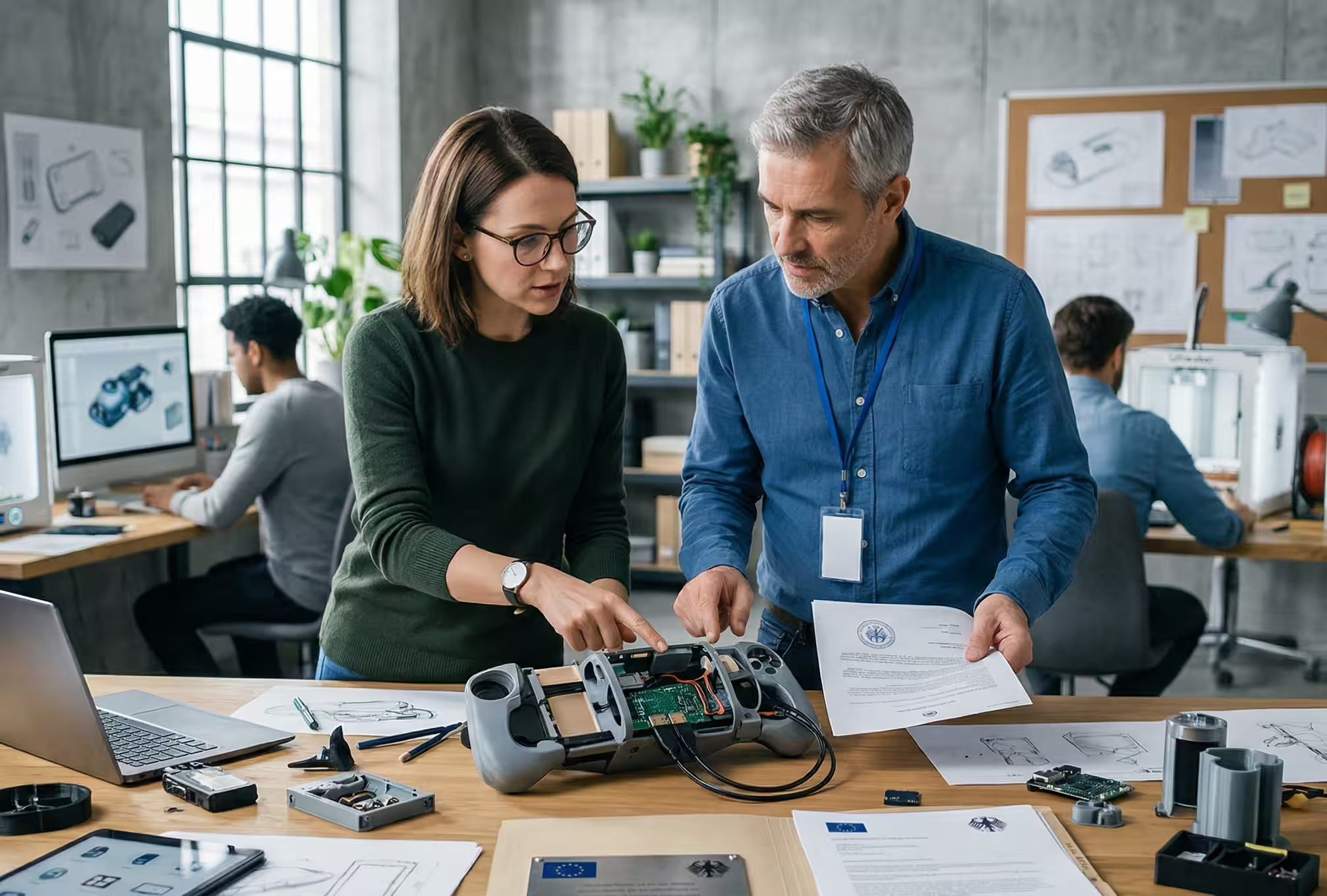
The most successful products are created where both disciplines work hand in hand. At PROJEKTER Industrial Design, we follow exactly this integrated approach. Our designers understand manufacturing, our manufacturing experts understand design.
This approach has concrete benefits:
Faster time to market: If it is clear from the outset how a product is manufactured, subsequent, expensive redesigns are unnecessary. What looks great in a 3D model often fails due to the reality of the production hall. Anyone who knows both worlds avoids this trap.
Lower development costs: Any design change in a late project phase costs money and time. Tools must be adapted, prototypes must be rebuilt, tests repeated. A well-thought-out design from the start saves these loops.
Higher product quality: A product that is both user-centred and production-ready is convincing across the board. It works better, feels better and lasts longer.
The Role of Prototyping
Another advantage of the integrated approach becomes apparent in prototyping. In our own prototype manufacturing, we can make ideas tangible quickly. This allows early testing of whether a design works and how it feels. This iterative way of working connects conceptual product design with the feasibility validation of industrial design.
Future Trends: How Industrial Design and Product Design Are Evolving
The boundaries between industrial design and product design are becoming increasingly blurred. New technologies such as 3D printing, generative AI and digital twins are fundamentally changing both disciplines.
Additive manufacturing enables complex geometries that were previously impossible to produce. This opens up new freedoms for designers, but also requires new knowledge of these manufacturing processes. Suddenly, forms are possible that were previously unthinkable - challenging classical industrial design.
Sustainability is becoming a central design criterion. Designers today must think about the entire product lifecycle: material origin, energy consumption in production, the use phase, and recyclability. This requires a holistic perspective that unites both disciplines.
Digitization is fundamentally changing the way designers work. Virtual reality makes it possible to experience designs before the first prototype is built. Simulation software tests loads and material behavior digitally. This accelerates the design process and simultaneously makes it more precise.
Artificial intelligence is transforming the way industrial designers work, and faster than most anticipated. Generative AI tools now make it possible to produce dozens of design variants in minutes, serving as a starting point for further development. What once required hours of sketching can today be explored almost instantly. Beyond ideation, AI supports the simulation of material properties, the optimization of components for specific manufacturing processes, and the early detection of structural weaknesses.
Crucially, AI does not replace the designer's creative judgment - it dramatically expands the space of possibilities. Industrial design and product design benefit in different ways: product designers leverage AI heavily in the concept and ideation phase, while industrial designers use it primarily for manufacturing optimization. The result is shorter development cycles, more iterations in less time, and ultimately better products.
Design for Circular Economy
A particularly compelling trend is the circular economy. Products are no longer conceived linearly (produce, use, discard) but circularly. This means every component must be able to re-enter the cycle at the end of its life. Designers today must already think about disassembly and reuse. Here, industrial design and product design merge completely - it is about user-centered design AND manufacturing-appropriate construction AND sustainable material selection.
Why the Distinction Ultimately Does Not Matter That Much
After all of these explanations, we arrive at a surprising insight: the terminological distinction between industrial design and product design is often secondary in day-to-day work. What matters is that all relevant aspects are addressed:
- Does the design team understand the needs of users?
- Do the designers know the capabilities and limitations of manufacturing?
- Is thinking sustainable and future-oriented?
- Does the price-to-performance ratio work?
- Does the product align with the brand strategy?
A good design team masters all of these dimensions, regardless of whether the business card reads "industrial designer" or "product designer". At PROJEKTER, we work with a team that can do both – and sets the appropriate emphases depending on the project phase.
Conclusion: Integrated Design Is the Future
Industrial design and product design are not opposites – they are two sides of the same coin. Industrial design brings the technical know-how and manufacturing expertise; product design brings the user-centered perspective and conceptual strength. The best results emerge where both approaches converge.
For companies looking to develop new products, this means: seek partners who understand both worlds. Those who not only deliver beautiful concepts but can also bring them into production. Who know your manufacturing environment, understand your processes, and still think innovatively.
With over 20 years of experience and more than 800 developed products We have learned at PROJEKTER: The most successful projects are those in which we take on both perspectives right from the start. Where we don't just ask “What should it look like?” , but also “How do we build it?” And where we don't just ask “How do we make it?” , but also “What does it feel like for the user?”
Precisely this combination makes the difference between a good and a great product. And ultimately, that is the only distinction that truly counts.